
Other proceedings Judicial Review
R (TDB) v London Borough of Haringey (Mind intervening)
15th September 2026
Summary[1]
T was 25 with diagnoses of autism, ADHD, a speech and language disorder and personality disorder. In October 2024 his solicitor wrote to the local authority about his long-standing difficulties with relationships and sexual boundaries, and asked for input from a psychologist and from learning disability and autism specialists. The Care Act needs assessment completed on 13 December 2024 recorded that “T lacks capacity in understanding relationships/sexual relationships and boundaries of relationships,” although this information came from the placement provider; the assessor had not assessed capacity herself (paragraph 19).
The legality of the Care Act assessment was challenged principally because no capacity assessment had been undertaken before his needs assessment was completed. This was originally dismissed ([2025] EWHC 2014 (Admin)) because the assessors had proceeded on the basis that T lacked capacity about healthy sexual relationships, T was “entitled to the important presumption of capacity,” and nothing suggested cause for concern about his capacity “to make a specific decision after appropriate support has been offered.”
The Court of Appeal allowed the appeal. Baker LJ (with whom May LJ and Bean LJ agreed) held:
… whenever there is a reason to doubt the capacity of a person whose needs for care and support are being assessed under the Care Act, a capacity assessment under the MCA must be carried out by an appropriately qualified professional before the Care Act assessment of needs is completed. (paragraph 91)
This was “clear from the provisions of the Act itself as well as the guidance” (paragraph 92). Well-being under s.1(2) (control over day-to-day life, participation, personal relationships) cannot be evaluated without considering capacity; the s.1(3) matters require “a clear understanding of the individual’s capacity to make decisions in the various domains in which his well-being is under consideration;” ss.9(5)(c), 11 and 25(3) refer to capacity expressly; the regulation 3 duties in the Care and Support (Assessment) Regulations 2014 depend on it; and paragraphs 6.32 and 10.63 of the Statutory Guidance reinforce the point (paragraphs 93–97). The capacity assessment must comply with ss.1–3 MCA and with paragraphs 4.34, 4.35, 4.38 and 4.42 of the Code of Practice (paragraph 98).
On the facts, there was clear evidence of incapacity in at least one respect, cited in the assessment itself, and “plainly reason to believe” that T might lack capacity in other areas (paragraph 100). Baker LJ agreed with the argument advanced on T’s behalf that the positive behaviour support response was “not a proper assessment of need nor an adequate analysis of how to meet it:” without a capacity assessment the local authority could not judge whether that level of support was appropriate (paragraph 101).
Baker J rejected the argument that there was no decision for T to make (and no need to consider his capacity): his relationships, contact with others and internet use were all in issue (paragraph 103). And the duty to arrange independent advocacy under s.67 of the Care Act did not remove the need to assess capacity; s.67 is about involvement in the Care Act assessment process, and “has no relevance to the question whether the individual has capacity to make decisions about aspects of his life” (paragraph 104).
Neither the presumption in s.1(2) MCA nor the practicable steps principle in s.1(3) is “a reason for deciding not to assess capacity when it is in doubt” (paragraph 105, endorsing Swift J in Royal Bank of Scotland plc v AB). Baker LJ added that the decision not to assess may have been influenced by the view that T did not have a learning disability. But s.2(1) MCA refers to impairment or disturbance, not disability, and a formal diagnosis is not required (paragraph 106, endorsing North Bristol NHS Trust v R [2023] EWCOP 5 at [48]).
On ground 2, Baker LJ emphasised that regulation 5 of the 2014 Regulations is mandatory. While recognising “the very considerable skill and expertise” of the social worker, the Court held that, given T’s complex diagnoses and needs, the local authority ought to have sought the advice of a psychiatrist or psychologist in conducting the Care Act assessment process. The failure to seek psychology input was irrational, and the judge had not engaged with the specific input sought (paragraphs 109–110).
The assessment was quashed. Subject to further submissions, the Court would not order a fresh Care Act assessment, because decisions about T’s care were now before the Court of Protection so “It is for that court to decide on any further assessments” (paragraph 111).
Comment
Baker LJ found it “puzzling” that this point had not arisen for consideration in the nineteen years since the MCA came into force. Mind’s submissions (set out at paragraphs 84 and 85 of the judgment) set out how capacity can be relevant to consideration of needs under the Care Act 2014, both substantively and procedurally. Those submissions also included a Venn diagram (not reproduced in the judgment, but which Mind have given permission for us to reproduce):
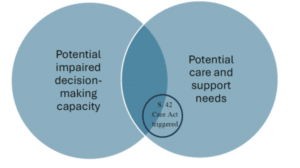
(“Potential impaired decision-making capacity” means “the person may lack capacity to make a relevant decision or decisions applying the test under the MCA 2005”).
As to the type of decisions which the capacity assessor may need to address, paragraph 104 refers to capacity “to make decisions relevant to his needs” and paragraph 94 refers to the “individual’s capacity to make decisions in the various domains in which his well-being is under consideration.”
Importantly and to correct a misunderstanding that we have seen the judgment does not say ‘assess capacity first; eligible needs second’. Rather, it says that the capacity assessment must happen before the needs assessment is completed. This is because the person’s decision-making capacity could be relevant at different stages, both to the identification and characterisation of needs and how they are to be met and may need to be revisited during the care planning stage.
In terms of who assesses capacity, this must be an “appropriately qualified professional”. Paragraphs 4.38 and 4.42 of the MCA Code refer to the person proposing to make the decision or take the action, with professional advice where the decision is complex. Similarly, paragraph 10.63 of the Care Act Guidance refers to “a social worker or other suitably qualified professional”. The Court noted at paragraph 99 that:
There is, of course a risk that this judgment may impose an additional layer of work on local authorities, and some extra costs. But the purpose of assessing capacity is to improve the chances of arriving at a more accurate assessment of the individual’s needs. That can only be to the benefit of the individual and in due course should lead to a more efficient and effective use of the local authority’s resources.
In terms of needs assessments, the Care Act guidance at paragraphs 6.85–6.90 (reflecting Regulation 5 of the Care Act regulations) provide that assessors must have the “skills, knowledge and competence” to do the assessment, which can include (but is not limited to) registered social workers, occupational therapists and rehabilitation officers. Importantly, and the judgment makes clear, part of the skill set of an assessor is recognising when they need to consult with a person with specialist expertise where required.
[1] Tor, Alex and Annabel having been in this case, they have not contributed to this note.
Contact Us


Peter Campbell
Director of Clerking

Sheraton Doyle
Director of Clerking



Elliott Hurrell
Director of Clerking