
GOING NUCLEAR: Nuclear Taskforce Review – Tolerability of Risk and the Safety Assessment Principles consultation
18th September 2026
In May, at our seminar, “Shaking up Britain’s nuclear sector”, we evaluated the Government’s response to the Nuclear Regulatory Review 2025, otherwise known as the Fingleton review. My focus was the question of proportionality and risk management – in particular the meaning of “Tolerability of Risk” (“ToR”) for nuclear, given the modern state of the nuclear sector, and demands for energy, decommissioning and defence. In this Insight, I consider the steps that have been taken to implement recommendations 6 and 7 from the Taskforce, namely the Government’s progress in defining ToR and the review of the Safety Assessment Principles (“SAPs”) by the Office for Nuclear Regulation (“ONR”).
The Taskforce highlighted that the application of the As Low As Reasonably Practicable (“ALARP”)[1] principle had “become overly stringent”, due to a “culture of risk aversion”.[2] The Taskforce observed that the principle “functions as a ratchet that demands ever-lower risk levels and radiation exposures, even when the benefits are negligible or the costs disproportionate”.[3] Thus the balance has shifted to “as low as” rather than what is “reasonable practicable” in ALARP.[4] The Taskforce attributed this shift to the lack of a clear meaning of ToR.
ToR arose in the Layfield inquiry into Sizewell B in 1987.[5] Sir Frank Layfield recommended that the Health and Safety Executive should “formulate and publish guidelines on the tolerable levels of individual and social risk to workers and the public from nuclear power stations.”[6] It was developed into the ToR framework. The ToR triangle sets regions of risk, from broadly acceptable to tolerable to unacceptable: [7]
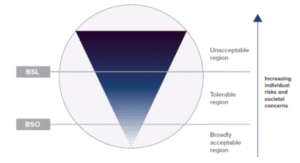
The ONR’s SAPs are based on this framework and set numerical risk targets called Basic Safety Levels (“BSLs”) and Basic Safety Objectives (“BSOs”) to ascertain the different risk regions (illustrated by the triangle above).[8] The SAPs are regulatory guidance, which along with the relevant regulations[9], embed the international system of radiological protection, built around the core principles of justification, optimisation and dose limitation.[10]
The ONR’s policy is that a new facility or activity should meet the BSLs.[11] The Taskforce explained ONR’s approach to SAPs as follows:[12]
“[…] Continuing to operate while failing to meet a BSL would only be acceptable if the dutyholder can demonstrate that there are no options that are reasonably practicable in the short term. There needs to be a clear plan to reduce risks within a period as short as reasonably practicable if operation is to continue. ONR will consider taking regulatory action to shut down the facility or prohibit or curtail the activity where a BSL is exceeded.
“ONR policy is that the BSOs form benchmarks that reflect modern safety standards and expectations, providing a value beyond which it is recognised further consideration by ONR of the safety case would not be a reasonable use of resources. ONR states that the dutyholder is not given the option of stopping at this level. ALARP considerations may be such that the dutyholder is justified in stopping before reaching the BSO, but if it is reasonably practicable to provide a higher standard of safety, then the dutyholder must do so by law.”
The Taskforce noted that the annual fatality risk target and the assumptions in relation to low doses means that the BSOs are “over a hundred times less than that which the average person in the UK normally receives in a year” (as one example).[13] Not only are the levels “overly conservative”, the SAPs have also been amended over time to lower the dose levels further.[14]
The Taskforce advised as follows:[15]
“Defenders of the current approach argue that the BSOs are only a guide to inspectors when not to pursue further and therefore are not binding. However, the SAPs clearly state that the BSOs “reflect modern standards and expectations”. As a result, both dutyholders and regulators treat these as true “targets” and “objectives” (as the names imply).
“This is one clear example of over regulation and there are others. Not all the numerical targets have similar issues. While some of them reflect high hazard potential with associated societal risks and concerns, they should all be reviewed to ensure proportionality. More generally, BSOs and BSLs have become inflexible across the whole sector despite the contextual nature of tolerability. […]”
Thus, the Taskforce advised, as recommendation 6, that BSLs and BSOs should defined by government based upon its judgement as to how society values the benefits and risks of nuclear activity, given the changes in technology and threats from climate change. Once defined, the regulator can then implement them, noting that:[16]
“Government has failed to provide sufficient clarity in this area. Regulators have had to fill this gap.”
Recommendation 6 went hand in hand with recommendation 7, which advised that the ONR’s guidance should be reviewed in line with the revised ToR. The Taskforce was concerned that the SAPs needed to be updated to “prevent them being used as a set of prescriptive requirements for dutyholders” and to ensure they accurately relevant “Relevant Good Practice” (which is used to demonstrated that risks are reduced to ALARP).[17]
The Government explained, in its response to the Taskforce, that it would appoint an expert advisory panel to consider and advise on the definition and applicability of the ToR, which includes the appropriateness of directing “ONR that risks at or below broadly acceptable levels are deemed to be ALARP and As Low As Reasonably Achievable (ALARA) unless there are compelling reasons to the contrary.”[18] The Nuclear Innovation and Research Advisory Board (“NIRAB”) was called upon by the Government to provide that advice and is currently gathering evidence, including oral evidence.[19] The Government had indicated that the panel would report by June 2026 so that it could feed into the ONR’s regulatory and SAP review, but there appears to have been some slippage given an initial deadline of 31 August 2026.
The ONR’s SAP review is well underway. The consultation on the draft principles closes today (18 September 2026) and the current intention is that the new versions will be published in December 2026. But the ONR will need to take into account the Nuclear Innovation and Research Advisory Board’s (“NIRAB”) advice in reviewing the SAPs, so there may be slippage.
The SAP review has been intended to update the principles, as well as refining and streamlining them.[20] They have been drafted with the input of artificial intelligence to more clearly articulate the regulatory expectations.[21] The draft provides fundamental principles, before setting out:
- A newly revised risk framework, based upon risk indicators and BSOs with Regulatory Focus Levels (“RFLs”), with updated numerical values for the RFLs. The RFLs are where the ONR is likely to prioritise its regulatory attention (as the new terminology would suggest). The RFLs are for the inspectors, rather than the dutyholders who are able to determine the metrics that are most appropriate for their operations. If the RFL are met, then inspectors are not to seek additional safety improvements because “the RFLs represent a level of risk so low that, below that level, ONR would not normally devote regulatory attention, even if some further reductions were technically possible”.[22]
- The structural integrity SAPs have been significantly amended, to remove duplication and overlap, as well as being set at a higher level, and dealing with materials, manufacturing, inspection and defect considerations. The revised SAPs also deal with materials behaviour (in accordance with the intention to be technology neutral).
- The external and internal hazard SAPs provide greater flexibility and a set of principles to identify hazard identification, screening and analysis.
- On safety cases, which are principally for the operators rather than the regulator, the revised SAPs confirm the ownership of the safety cases and adopt a graded approach in relation to the safety justification (based upon the level of risk and hazard).
Clearly, the final version of the SAPs will very much depend upon the NIRAB’s advice to the Government in relation to defining the ToR and risk levels. It will be interesting to see how far the advice, then the Government goes in relation to adopting a deeming approach whereby certain levels constituting ALARP. The Government is no doubt serious about the growth of nuclear here, but it will need to be bold in setting the levels and ensuring the risk associated with nuclear is more proportionately managed.
[1] ALARP is derived from sections 2 and 3 of the Health and Safety at Work Act 1974.
[2] https://www.gov.uk/government/publications/nuclear-regulatory-taskforce
[8] Ibid, Chapter 6, paras 200 and 201
[9] Ionising Radiation Regulations 2017 and Radiation (Emergency Preparedness and Protection) Regulations 2019
[10] Ibid, Chapter 6, para 201
[11] Ibid, Chapter 6, para 211
[12] Ibid, Chapter 6, paras 211-212
[13] Ibid, Chapter 6, para 215
[14] Ibid, Chapter 6, paras 218, 219
[15] Ibid, Chapter 6, paras 221-222
[16] Ibid, Chapter 6, para 225
[17] Ibid, Chapter 6 paras 229, 238
[18] https://www.gov.uk/government/publications/building-our-nuclear-nation-government-response-to-the-nuclear-regulatory-review-2025, pg 25
[19] https://niro.org.uk/about-nirab/
[20] https://www.onr.org.uk/working-with-others/public-participation/consultations/open-consultations/safety-assessment-principles-consultation-2026
[21] ‘ONR Consultation Document – 2026 Safety Assessment Principles (SAPs)’ (dated 27 July 2026), pg 4: “With human oversight, Artificial Intelligence has been used to enhance the drafting process, resulting in a clearer articulation of regulatory expectations in the revised SAPs.”
Author(s)

Contact Us


Elliott Hurrell
Director of Clerking